The Dominican Republic’s top places to visit are Punta Cana and Bávaro, the Colonial City of Santo Domingo, the Samaná Peninsula, Los Haitises National Park, Bahía de las Águilas, Saona Island, Puerto Plata, Cabarete, Pico Duarte, and Lake Enriquillo. The country closed 2025 with 11.6 million visitors — 4.3% more than 2024 and the highest annual total in its history — according to Ministry of Tourism figures presented by Tourism Minister David Collado, including 2.8 million cruise passengers. See the Americas travel guides for how the Dominican Republic ranks among Caribbean and Central American destinations.
- Punta Cana & Bávaro — The resort coast most arrivals see first. La Altagracia province’s coastline runs 100 kilometers, and Grupo Puntacana built the airport serving it in 1984 — the western hemisphere’s first privately owned international airport.
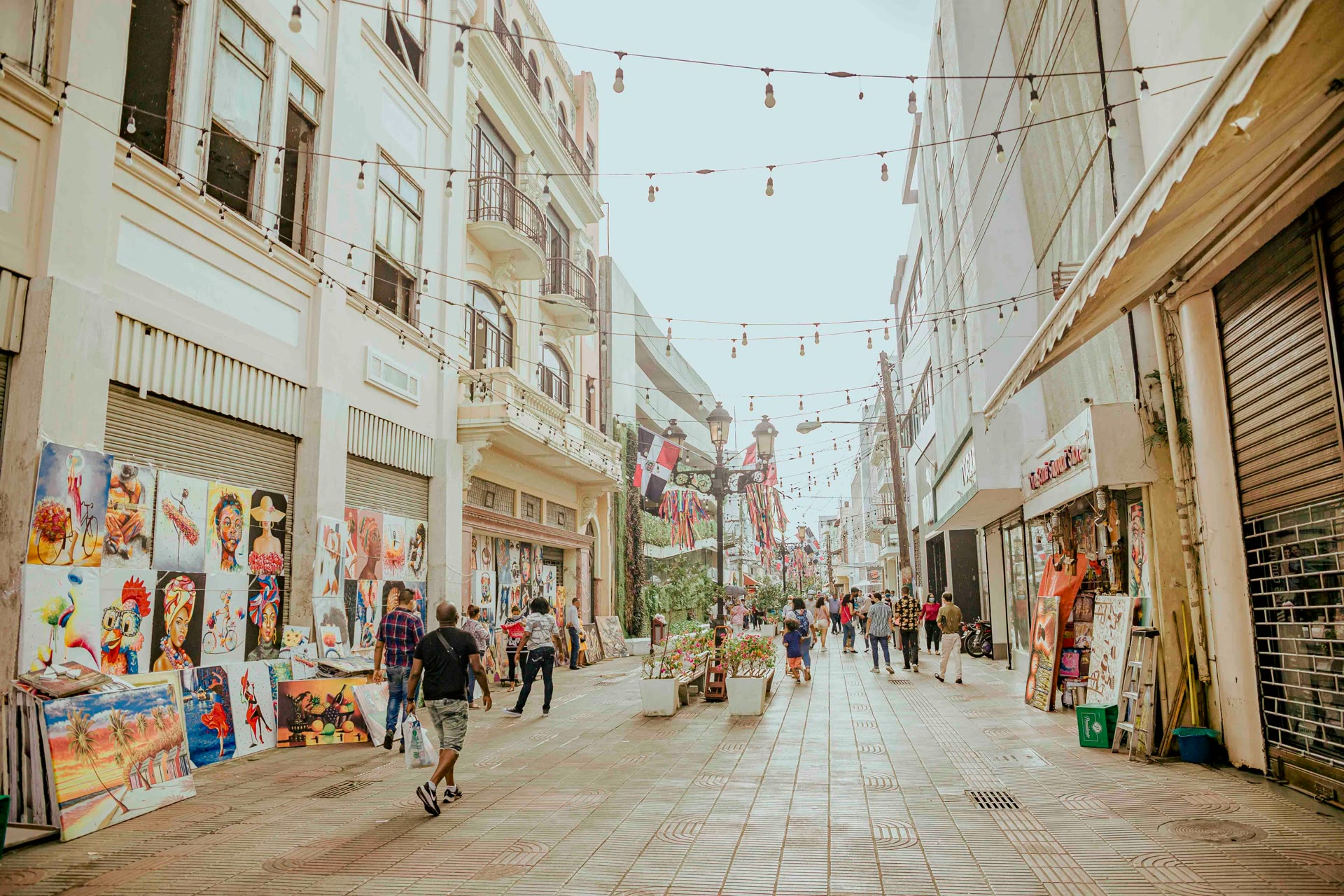
- Colonial City of Santo Domingo — UNESCO-inscribed in 1990 and the oldest continuously inhabited European-established settlement in the Americas. The Basilica Cathedral of Santa María la Menor is the First Cathedral of the Americas; the cobblestone Calle Las Damas, dating from 1502, is the New World’s oldest paved street; and the Casa del Cordón, also 1502, is perhaps the oldest still-standing stone building in the New World.
- Samaná Peninsula — Samaná Bay is a significant Caribbean breeding site for humpback whales, and the breeding season is what draws whale-watchers. The Dominican Republic established the Silver and Navidad Bank Sanctuary on October 14, 1986, enlarged by presidential decree on July 5, 1996 into the Sanctuary for Marine Mammals.
- Los Haitises National Park — Created by Law 409 on June 3, 1976 and covering 826 square kilometers of limestone karst plateau — conical hills, sinkholes, caverns — fringed by coastal mangrove forest. Some of the caverns hold pictographs and petroglyphs left by the island’s Native American inhabitants.
- Bahía de las Águilas — A remote beach inside Jaragua National Park, established August 11, 1983 and, at 1,374 square kilometers (905 of them offshore marine habitat), the largest protected area in the Caribbean.
- Saona Island — A 110-square-kilometer island within Cotubanamá National Park, drawing over a million visitors a year. It is not empty: the town of Mano Juan and the Catuano naval base are permanent settlements, with about 300 residents.
- Puerto Plata — Victorian architecture dating from 1857, the Fortaleza San Felipe finished in 1577, and the Museo del Ámbar Dominicano, founded 1982. Above the city, the 739-meter Pico Isabel de Torres is reached by a Teleférico inaugurated in 1975 — the first aerial tramway in the Caribbean.
- Cabarete — The north-coast watersports town, repeatedly host to the Professional Windsurfing World Cup along with kitesurfing events including the PKRA and WKL circuits and the multi-discipline Master of the Ocean. Nearby Playa Encuentro is among Central America’s most consistent surf beaches.
- Pico Duarte — The highest peak in the Dominican Republic, on Hispaniola and in the whole Caribbean, remeasured in 2021 at 3,101 meters. The main trail runs 23.1 kilometers to the summit with 1,977 meters of total elevation change, so plan on an overnight in the mountain shelter rather than a day hike.
- Lake Enriquillo — The Caribbean’s largest lake, sitting 46 meters below sea level — the lowest point of any island country. It is hypersaline, holds the Caribbean’s largest American crocodile population, and supports both endangered Hispaniolan iguanas, with flamingo flocks concentrated around Isla Cabritos.
Planning note
The country is small enough to tempt you into treating it as one loop, and the map punishes that. Punta Cana sits on the far eastern tip, Lake Enriquillo and Bahía de las Águilas are down in the arid southwest near the Haitian border, Cabarete and Puerto Plata are on the north coast, and Pico Duarte is a multi-day trek in the central mountains. Most visitors arrive at Punta Cana — its airport takes 64% of all flights arriving in the country and more passengers than Las Américas in Santo Domingo — which makes the east coast and Saona easy, and everything else a deliberate detour. Pick two regions rather than four, and consider an open-jaw booking into Punta Cana and out of Puerto Plata (or the reverse) if you want both coasts without backtracking. For budgeting a multi-region trip, check Americas trip cost breakdowns.
Sources
- Ministry of Tourism of the Dominican Republic — República Dominicana marca hito histórico: 11.6 millones de visitantes en 2025
- Infobae / EFE — República Dominicana logra récord histórico al recibir 11,6 millones de turistas en 2025
- Wikipedia — Punta Cana
- Wikipedia — Ciudad Colonial (Santo Domingo)
- Wikipedia — Samaná Bay
- Wikipedia — Silver Bank
- Wikipedia — Los Haitises National Park
- Wikipedia — Jaragua National Park
- Wikipedia — Saona Island
- Wikipedia — Puerto Plata, Dominican Republic
- Wikipedia — Cabarete
- Wikipedia — Pico Duarte
- Wikipedia — Lake Enriquillo
Read the Top 10 Countries to Visit in 2026 roundup for how the Dominican Republic compares globally.