The top places to visit in Uzbekistan are the Registan, Shah-i-Zinda, and Gur-e-Amir in Samarkand, the historic centre of Bukhara, Khiva’s Itchan Kala, Shahrisabz, the Tashkent Metro, the Nukus Museum of Art, Moynaq, and the silk town of Margilan. According to the country’s Statistics Agency, as reported by Kun.uz, 8.2 million foreign nationals visited Uzbekistan for tourism purposes in 2024, up from 6.6 million in 2023.
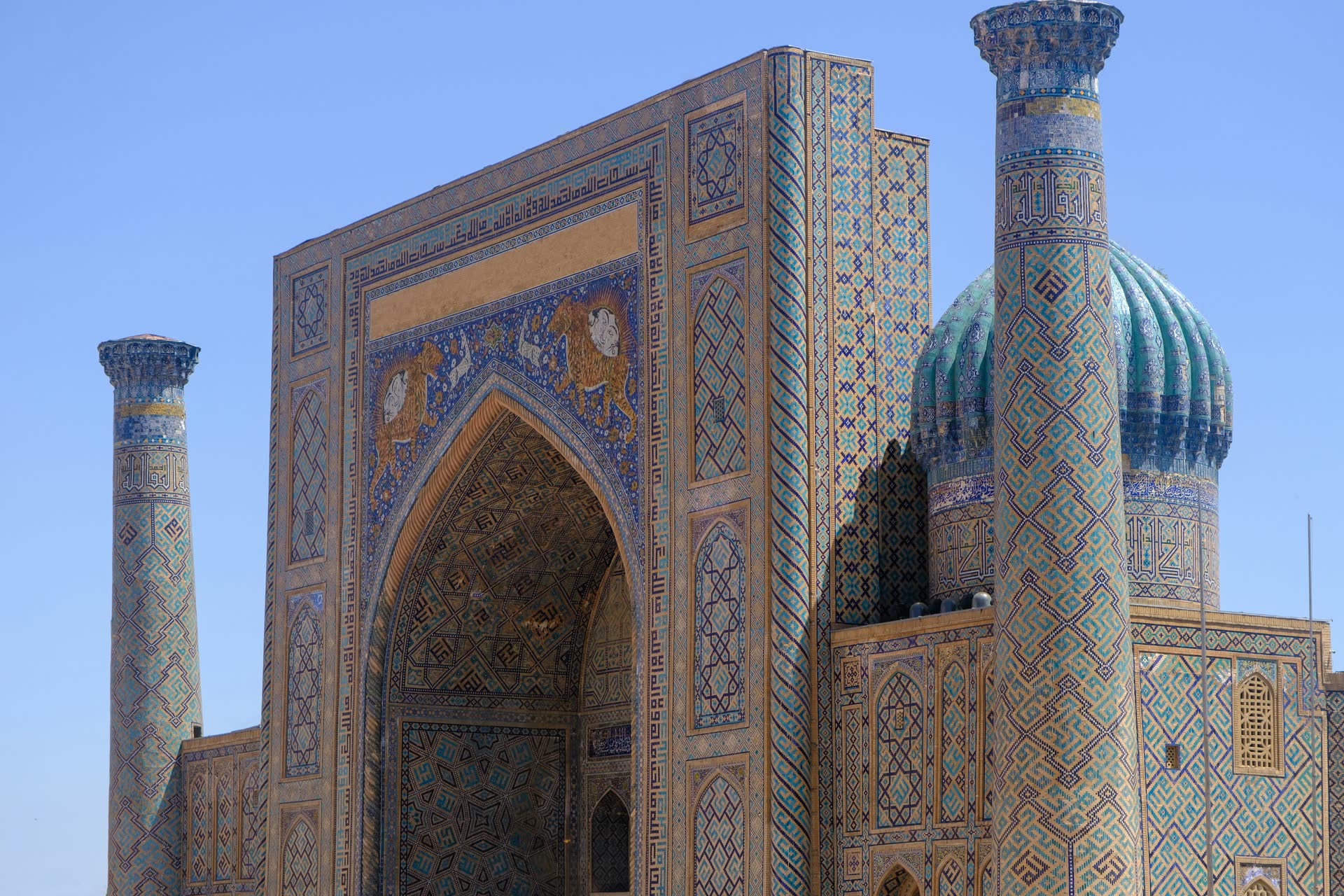
- The Registan, Samarkand — A historic public square that served as the heart of the Timurid Empire, framed by three madrasas: Ulugh Beg (1417–1420), Sherdar (1619–1636), and Tilakari (1646–1660). The Sherdar takes its name from the tigers on its portal (“sher” means tiger), shown in mosaic with a rising sun on their backs. Samarkand’s historic city was inscribed on the UNESCO World Heritage List in 2001 as “Samarkand – Crossroads of Cultures.”
- Shah-i-Zinda, Samarkand — A necropolis in the north-eastern part of the city, formed over eight centuries (the 11th to the 19th) and now made up of more than twenty buildings. Its name means “the Living King,” after a legend connected with Qutham ibn Abbas, a cousin of the Prophet Muhammad, who is said to be buried here.
- Gur-e-Amir, Samarkand — The mausoleum of the conqueror Timur, under an azure fluted dome. Construction began after the sudden death of Timur’s grandson and heir apparent Muhammad Sultan, for whom it was intended; it later became the Timurid family crypt, holding the tombs of Timur, his sons Shah Rukh and Miran Shah, and his grandsons Ulugh Beg and Muhammad Sultan.
- Bukhara’s historic centre — Bukhara has about 140 architectural monuments, and UNESCO listed its historic centre as a World Heritage Site in 1993. Among them are the Ark, a massive fortress initially built and occupied around the 5th century AD, and the Kalyan Minaret, built in 1127 by the Qarakhanid ruler Mohammad Arslan Khan and standing 45.6 metres high (48 metres including the point).
- Itchan Kala, Khiva — The walled inner town of Khiva, protected as a World Heritage Site since 1990. It retains more than 50 historic monuments and 250 old houses, dating primarily from the 18th or 19th centuries, behind mud-brick walls 8–10 metres high. The Juma Mosque’s hypostyle hall still holds 112 columns taken from ancient structures.
- Shahrisabz — About 80 km south of Samarkand, this city is best known as the birthplace of Timur. Work on his Ak-Saray (“White Palace”) started in 1380; only parts of its 65-metre gate-towers survive. The historic centre was inscribed by UNESCO in 2000 and has been on the List of World Heritage in Danger since 2016; the destruction of vast areas of the medieval townscape in 2015, to create a park and tourist facilities, drew concern from UNESCO.
- The Tashkent Metro — Opened on 6 November 1977, it was the seventh metro system built in the USSR and the first in Central Asia. Each station is designed around a particular theme, often reflected in the station’s name.
- The Nukus Museum of Art — Established in 1966 at the behest of Igor Savitsky, its first curator, the museum in Nukus, Karakalpakstan, holds the world’s second-largest collection of Russian avant-garde art — including Constructivist, Cubist, and Futurist work of the kind banned under Stalin in the 1930s — among more than 82,000 items.
- Moynaq — Formerly a port on the Aral Sea, the town now sits in the Aralkum Desert; a 1960s Soviet diversion of the Amu Darya and Syr Darya rivers cut off the sea’s inflows and much of it dried up. Its major attractions are the rusting hulks of its Soviet-era fishing fleet and a one-room museum devoted to its fishing heritage, with the Aral Sea Memorial standing among the ships.
- Margilan — In the south of the Fergana Valley, Margilan has been renowned for its silk goods since as far back as the 10th century. The Yodgorlik Silk Factory, established in 1983 to preserve traditional weaving techniques, runs the whole process on site, from feeding silkworms mulberry leaves to dyeing with natural dyes and weaving, and is open to the public for guided tours.
Planning note
Three of these stops are in Samarkand itself, and Shahrisabz is about 80 km to its south, so they group naturally into one base. Bukhara, Khiva (in the Xorazm Region), and the Karakalpakstan pair of Nukus and Moynaq each need their own leg, as does Margilan in the Fergana Valley; the metro is in Tashkent, the capital. Pick the regions that match your interests rather than trying to cover all of them on one trip.
Sources
- Kun.uz — 8.2 million tourists visited Uzbekistan in 2024
- Wikipedia — Registan
- Wikipedia — Samarkand
- Wikipedia — Shah-i-Zinda
- Wikipedia — Gur-e-Amir
- Wikipedia — Bukhara
- Wikipedia — Ark of Bukhara
- Wikipedia — Kalyan Minaret
- Wikipedia — Itchan Kala
- Wikipedia — Shahrisabz
- Wikipedia — Tashkent Metro
- Wikipedia — Nukus Museum of Art
- Wikipedia — Moynaq
- Wikipedia — Margilan
Explore more of FarSerene’s destination guides, including the Top 10 Countries to Visit in 2026 roundup, for more 2026 trip inspiration.