Dubai welcomed 18.72 million overnight international visitors in 2024, a 9% increase over 2023’s previous record of 17.15 million, according to Dubai’s Department of Economy and Tourism. Most of that traffic arrives expecting Burj Khalifa and not much else — this guide covers the modern core plus the pre-oil merchant quarter across the Creek that most itineraries skip entirely.
Getting there
Dubai International Airport (DXB), just 9.56 km from downtown, is Dubai’s uncontested primary gateway and needs no caveat. Two secondary airports exist but serve different purposes: Sharjah International Airport (SHJ), 26.34 km away in the neighboring emirate, is a genuine option if you’re flying a budget carrier, since fares there often undercut DXB — factor in the emirate-crossing transfer time if you book it. Al Maktoum International Airport (DWC), 39.11 km out, currently handles cargo, general aviation, and a modest slate of passenger routes — mostly Russian and a handful of European carriers — with passenger numbers still under a million a year as of 2025; it is not yet a mainstream arrival point for international leisure travelers, though Dubai’s long-term plan is to shift all DXB operations there by around 2030.
Where to base yourself
Downtown Dubai, between Dubai Creek and Sheikh Zayed Road, is the default first-timer base — it puts Burj Khalifa, Dubai Mall, and the Dubai Fountain within walking distance and offers the city’s densest concentration of five-star hotels. Jumeirah, along the coast, suits travelers prioritizing beach access, with Jumeirah Beach Residence adding a walkable strip of restaurants and nightlife. Deira, Dubai’s older commercial quarter across the Creek, is the budget-friendlier and more locally textured option, and its proximity to the Gold Souk and the historic district below makes it the practical base for the itinerary in this guide.
Getting around
The Dubai Metro launched on September 9, 2009 — timed deliberately to 9/9/9 — as a fully automated, driverless system, and by 2012 the network (at 74.69 km) held the Guinness World Record for longest automated metro network in the world, a title since passed to Riyadh’s newer system as of late 2024. Today Dubai Metro runs close to 90 km across two lines and 55 stations, and its Red Line alone (52.1 km) still holds the record for longest driverless metro line. For the sites below, the Green Line is what matters — it serves the Al Fahidi/Bur Dubai historic district directly, while the Red Line covers Downtown and the newer coastal areas.
What’s actually worth your time
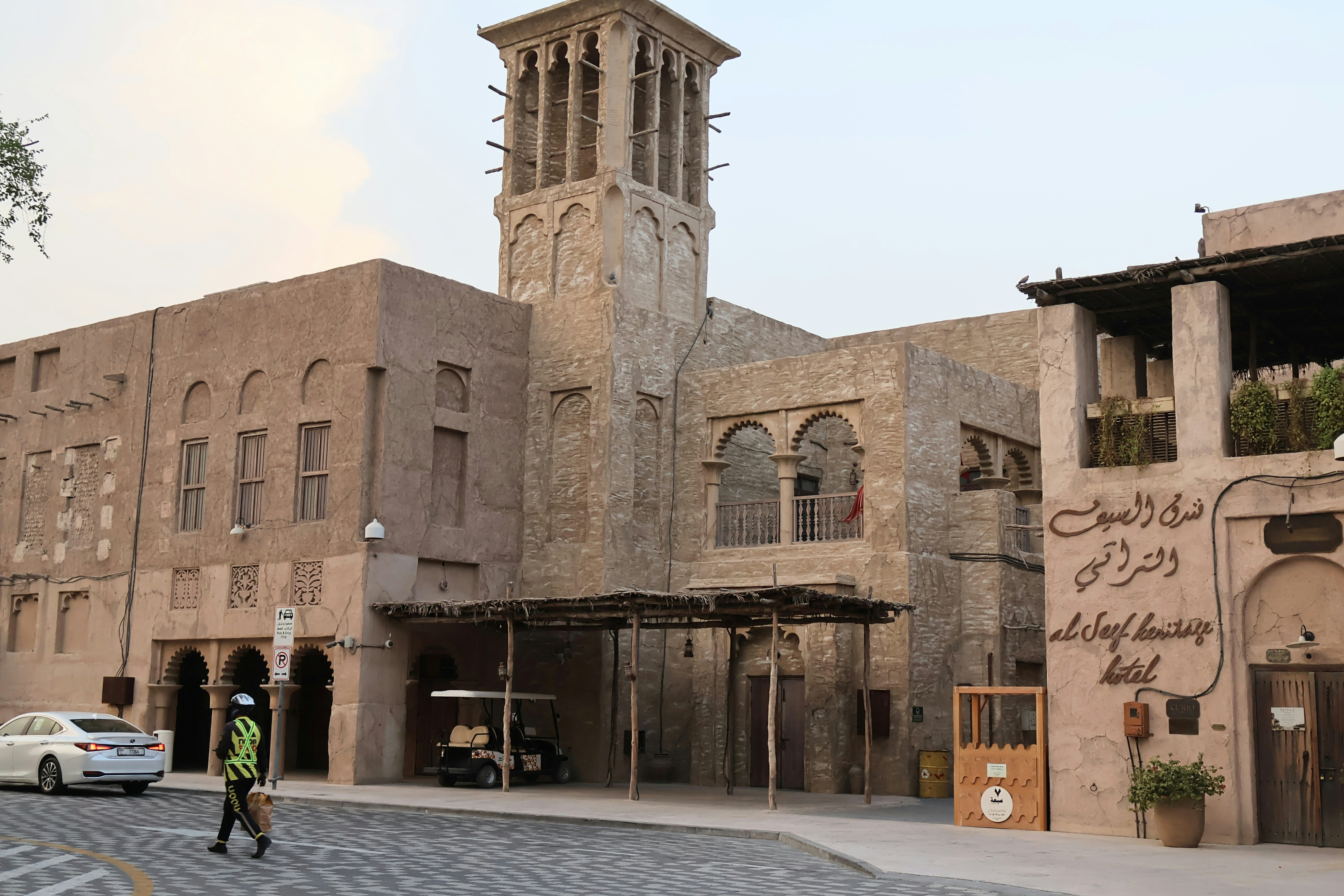
Al Bastakiya, also known as the Al Fahidi Historic District, is Dubai’s clearest counterpoint to the glass skyline: a merchant quarter built from the 1890s by Persian traders from the town of Bastak, who brought with them the wind-tower (barjeel) cooling technology that still defines the area’s rooflines. Around 50 of these pre-electric cooling towers survive in a small footprint, saved from demolition by heritage advocates in the 1980s and now a protected district under Dubai Culture & Arts Authority — one of the few places in the city where you can see pre-oil-boom architecture at any real scale.
The Jumeirah Archaeological Site, first excavated in 1969 by Dimitri Baramki and fully explored by 2008, uncovered a settlement dated roughly 900–1800 AD from the Islamic era, including a mosque, a caravanserai, residential buildings, and a market — evidence of Jumeirah’s role as a trading stop on routes linking Iraq and Oman centuries before Dubai’s modern port existed.
The Etihad Museum, built beside the restored Union House where UAE founding leaders signed the federation’s founding documents on December 2, 1971, opened to the public on January 7, 2017. Its folded-manuscript façade and seven interior columns are a deliberate design reference to the seven emirates and the pens used to sign the union agreement.
The Dubai Fountain, on the 12-hectare Burj Khalifa Lake in Downtown, opened on May 8, 2009, alongside the Dubai Mall — designed by WET, the firm behind the Bellagio fountains in Las Vegas, it’s recognized as the world’s largest choreographed fountain and remains a free, 20-minute evening stop that pairs naturally with a Downtown base.
The Museum of the Future, which opened February 22, 2022 (a date chosen for its 22.02.22 symmetry), is Dubai’s newest major cultural landmark — a 77-meter, pillar-less structure whose Arabic-calligraphy-clad exterior has become as photographed as Burj Khalifa itself.
Round out the itinerary with Safa Park and Zabeel Park, two of the city’s larger green spaces, useful as a change of pace rather than headline destinations.
Planning note
Split your time by era rather than by geography alone: pair Al Bastakiya, the Jumeirah Archaeological Site, and the Etihad Museum into a single Creek-side, pre-oil-history day using the Green Line, then treat Downtown’s Museum of the Future and Dubai Fountain as a separate, unrelated day — the two halves of Dubai’s story don’t overlap on the map, and trying to combine them means unnecessary backtracking across the Metro network.
Sources
- Business Recorder — Dubai sets new record of 18.72 mn international visitors in 2024
- FlightAware — Al Maktoum Int’l Airport (Dubai) DWC
- ITS International — Dubai metro: the world’s longest automated rail system
- Wikipedia — Al Bastakiya
- Wikipedia — Jumeirah Archaeological Site
- Wikipedia — Etihad Museum
- Wikipedia — The Dubai Fountain
- The National — Dubai’s Museum of the Future will open on February 22
- Rough Guides — Where To Stay In Dubai: Best Areas Guide
Read the Top Places to Visit in the United Arab Emirates roundup for how Dubai compares to Abu Dhabi and the other emirates.