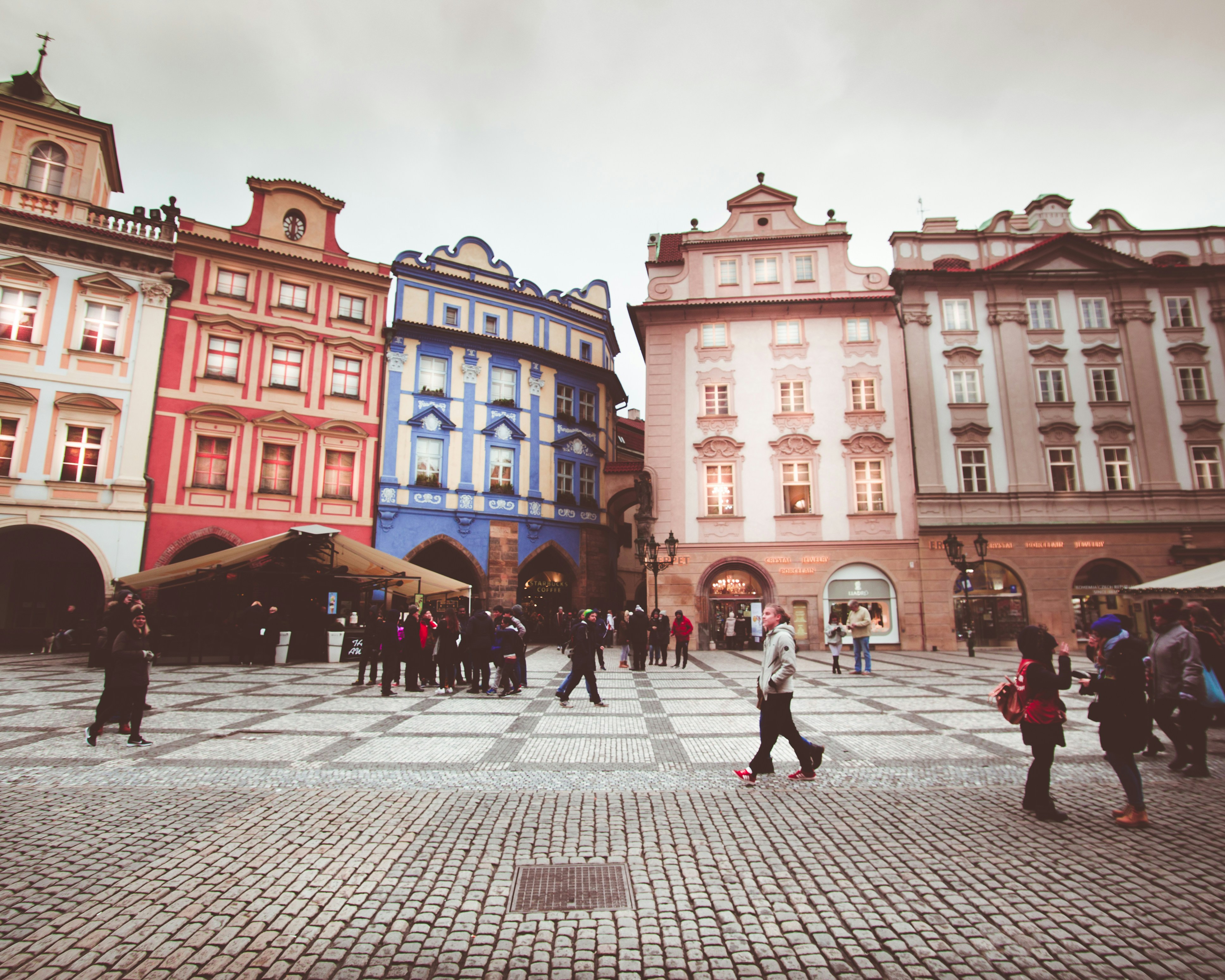
Prague pulled in roughly 8.1 million visitor arrivals in 2024, a 9% jump on 2023 that brought the city back to pre-pandemic levels, according to Prague City Tourism’s year-end reporting. Most of that traffic funnels through the same few blocks around Old Town Square and Charles Bridge — understanding how the city’s three neighborhoods and three metro lines actually relate to each other saves real time.
Where to base yourself
Staré Město (Old Town) is the default first-timer’s choice: almost every major sight is within walking distance, at the cost of a 20–30% hotel price premium over other neighborhoods, per local guides to the city’s districts. Malá Strana, across the river beneath the castle, trades some of that convenience for atmosphere — 13th-century lanes, Baroque palaces, and the closest hotels to Prague Castle itself, though the terrain is genuinely hilly. Vinohrady, a residential grid of Art Nouveau apartment blocks about 10 minutes from the center by metro, runs roughly 20% cheaper than Old Town and is where a lot of Prague’s own café culture actually lives, at the cost of a short commute in each day.
Getting there
Václav Havel Airport Prague (PRG) is the primary gateway, 13 km from the center and connected by direct bus to metro line A. Pardubice Airport (PED), 93 km out, and Karlovy Vary Airport (KLV), 109 km out, handle limited seasonal and charter routes and aren’t practical arrival points for a first Prague trip.
Getting around
The Prague Metro opened its first line in 1974 — making Prague the 44th city in the world to build one — and now runs three lines (A, B, C) across 65.2 km and 61 stations, carrying roughly 1.55 million passengers a day as of 2021 ridership figures. It’s fast between neighborhoods but doesn’t replace walking inside Staré Město or Malá Strana, both small enough to cross on foot in 20–30 minutes. Prague’s tram network is older than the metro — the first horse-drawn line opened in 1875, electrified in 1891 — and today runs 35 lines across 518 km of route, useful for the castle district and other spots the metro’s radial lines don’t directly serve.
What’s actually worth your time
- Prague Castle — Guinness World Records lists it as the largest ancient castle complex on Earth, a roughly 70,000 m² core (up to 450,000 m² with gardens and grounds) that’s been continuously built up since Prince Bořivoj founded a fortified settlement here in the 9th century. Budget more than a quick photo stop; the complex includes St. Vitus Cathedral, several palaces, and multiple courtyards.
- Charles Bridge — Commissioned by Charles IV, with construction running from 1357 to 1402 under architect Petr Parléř, who also designed St. Vitus Cathedral. It carried the city’s only river crossing point for centuries and wasn’t officially named for Charles IV until 1870.
- Church of Our Lady before Týn — Its present Gothic structure was begun around 1360, but the two mismatched towers weren’t finished until 1510; a 1679 fire forced a Baroque rebuild of the nave that left the exterior’s Gothic silhouette largely intact.
- Strahov Monastery — Founded in 1143 as a Premonstratensian abbey, its famous library halls came centuries later: the Theological Hall dates to 1671–1674, the Philosophical Hall to 1794, and the combined collection now runs to roughly 200,000 volumes.
- St. Nicholas Church, Malá Strana — A three-generation family project: construction started in 1704 under Christoph Dientzenhofer, continued after his 1722 death under his son Kilian Ignaz, and was finished by Anselmo Lurago — around a century of work on one High Baroque church.
- Wallenstein Palace and Garden — Built 1624–1630 for Albrecht von Wallenstein, who had more than 20 houses demolished to make room and lived in the finished palace for barely a year before his 1634 assassination on the emperor’s orders. It’s been the seat of the Czech Senate since 1996; the 1.7-hectare garden is open to the public April through October.
Planning note
Old Town’s density means a short, walkable itinerary works fine for a two- or three-day trip, but Prague Castle alone can absorb the better part of a day once you factor in St. Vitus Cathedral and the surrounding courtyards — don’t stack it on the same afternoon as Charles Bridge and Old Town Square unless you’re moving fast. Malá Strana and Vinohrady both work as a base if you’re comfortable using the metro or tram once or twice a day rather than staying inside Old Town’s walking radius the whole trip.
Sources
- Prague – Nearly Six Million Visitors in 2024 — Prague Morning
- Prague: Top Visitor Magnet with 8.1 Million Tourists in 2024 — Prague Daily News
- Where to Stay in Prague — Best Prague Guide
- Prague Metro — Wikipedia
- Trams in Prague — Wikipedia
- Largest ancient castle — Guinness World Records
- Charles Bridge — Wikipedia
- Church of Our Lady before Týn — Wikipedia
- Strahov Monastery — Wikipedia
- St. Nicholas Church (Malá Strana) — Wikipedia
- Wallenstein Palace — Wikipedia
Read the Top Places to Visit in the Czech Republic roundup for how Prague fits into a wider Czech trip.