Sydney drew 3.53 million international visitors in the year ending December 2024, according to Tourism Research Australia and Destination NSW data — still about 14% below the city’s 2019 peak of 4.11 million, even as total visitor spending in the city has already surpassed pre-pandemic levels. Most first-time visitors plan their trip around the Opera House and Harbour Bridge and stop there. This guide covers the layer underneath that: where to actually base yourself, how the city’s transit patchwork fits together, and a cluster of CBD and Hyde Park-area landmarks that don’t make the postcard shortlist but carry real, dated history.
Where to base yourself
The CBD, Circular Quay, and The Rocks are the standard first-timer base — walking distance to the Opera House, Harbour Bridge, and the ferry terminals that link out to the harbor’s other neighborhoods. The Rocks and Circular Quay carry a premium for that location; travelers on a tighter budget typically stay slightly back in the wider CBD for a larger range of hotel options without losing easy transit access. For a different focus, Surry Hills — along with nearby Darlinghurst, Potts Point, and Paddington — is the pick for dining, café culture, and a more local pace, and is walkable to the CBD and Darling Harbour rather than requiring a transit leg. A common, workable strategy for a longer stay is splitting nights between the two: Circular Quay or the CBD for sightseeing days, Surry Hills for the rest.
Getting there
Sydney Kingsford Smith International Airport (SYD) sits just 3.2 km from the city center, making it one of the closest major international airports to a city core anywhere. Newcastle Airport (NTL), roughly 139 km north, is a secondary regional option worth checking only if your itinerary includes the Hunter Valley or the Central Coast on the way in or out.
Getting around
Sydney runs two separate rail systems that visitors often conflate. Sydney Trains, the older heavy-rail commuter network, traces back to the city’s first line in 1855. Sydney Metro, Australia’s first fully automated rapid transit system, opened its inaugural Metro North West Line on May 26, 2019, and was extended under the harbour and through the CBD to Sydenham on August 19, 2024 — a 15.5 km extension that drew over a million riders in its opening days. Both systems, along with buses, ferries, and light rail, run on the single Opal card fare system with a daily spending cap. The CBD, Circular Quay, The Rocks, Darling Harbour, and Surry Hills are all walkable to one another, which makes transit mainly a tool for reaching the harbor’s outer neighborhoods or the airport rather than for getting around the core.
What’s actually worth your time
- Australian Museum — Funded from 1827 under British Secretary of State Earl Bathurst, it’s Australia’s oldest museum and the fifth-oldest natural history museum in the world; its first permanent gallery, opened in 1857 on Hyde Park, remains the oldest museum gallery still operating in the country.
- Hyde Park Barracks — Opened June 4, 1819 by Governor Lachlan Macquarie, designed by convict-turned-architect Francis Greenway to house up to 600 convict men, it was inscribed on the UNESCO World Heritage List in 2010 as one of eleven Australian Convict Sites.
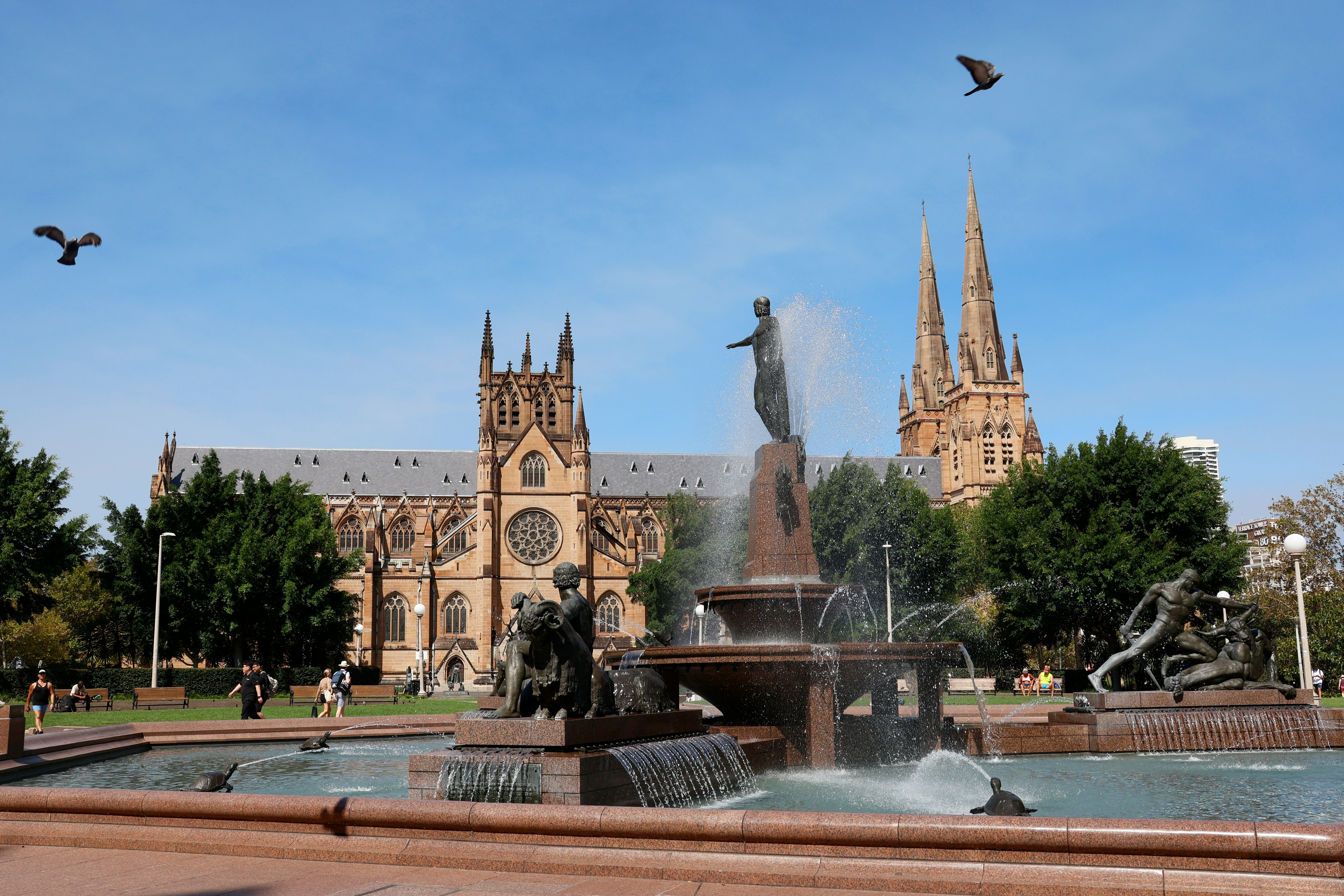
- St Mary’s Cathedral — Its foundation stone was laid October 29, 1821, but fire destroyed the original building in 1865; architect William Wardell’s replacement was built in stages from 1868 to 1928, and its twin spires weren’t finally completed — lifted into place by helicopter — until the year 2000, 132 years after Wardell’s design was drawn.
- Hyde Park — Reserved as open space by Governor Macquarie on February 11, 1810, it’s Australia’s oldest public parkland and hosted the country’s first official horse race meeting later that same year.
- Sydney Observatory — Built in 1858 on what’s now called Observatory Hill, its time ball dropped daily at 1pm to let ships in the harbour calibrate navigational chronometers, paired for decades with a signal cannon fired from Dawes Point and later Fort Denison.
- St James’ Church — Consecrated February 11, 1824, it began as a Francis Greenway-designed courthouse before colonial officials repurposed it as a church mid-construction; it’s the oldest church building still standing in inner Sydney, with its 52-meter copper steeple’s sheets stamped with arrows to deter theft.
- State Library of New South Wales — Traces to the 1826 Australian Subscription Library, transferred to public ownership in 1869; its Mitchell Library wing, opened in 1910, was the first library in the country built to hold Australian-specific collections exclusively.
Planning note
SYD’s short distance from the CBD means a taxi or the Airport Link train usually beats budgeting extra transfer time — but check which CBD-area hotel zone you’re in, since the Airport Link’s Green Square and Central stations aren’t equally close to every part of downtown. The Sydney Opera House and Harbour Bridge, both essential Sydney geography, sit just outside this list; treat a Circular Quay walk past them as the connective tissue between a CBD stay and the Hyde Park cluster above, not a separate leg of the trip.
Sources
- Number of international visitors to Australia — Statista, via Tourism Research Australia/Destination NSW
- Where to stay in Sydney first time: 9 Best areas — Travel Hotel Expert
- Sydney Metro — Wikipedia / About Sydney Metro
- Australia’s first metro system opened in Sydney — Urban Transport Magazine
- The Museum’s Early Days — The Australian Museum
- Hyde Park Barracks, Sydney — Wikipedia
- St Mary’s Cathedral, Sydney — Wikipedia
- Hyde Park, Sydney — Wikipedia
- Sydney Observatory — UNESCO Portal to the Heritage of Astronomy
- St James’ Church, Sydney — Wikipedia
- State Library of New South Wales — Wikipedia
Read the Top Places to Visit in Australia roundup for how Sydney fits into a wider trip.